AI Doesn’t Just Learn Medicine. It Learns Our Systems
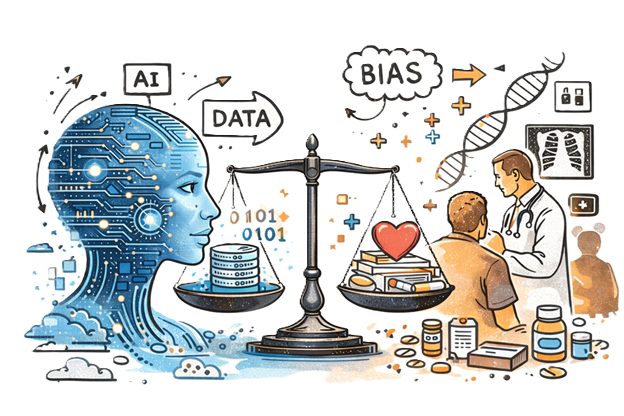
When AI Learns Our Blind Spots
Bias in healthcare AI is often discussed in obvious terms. Less visible, but more consequential, is the quiet bias embedded in the systems we rely on every day.
Foundational research on bias in big data and AI in healthcare such as the paper Addressing bias in big data and AI for health care: A call for open science (2021), highlights an important reality. The risk is not hypothetical and it is not dramatic. It is structural, persistent, and often invisible during routine implementation.
We often frame AI in healthcare as progress: faster diagnoses, operational efficiency, scalable decision-making. And much of that promise is real. Research in this area underscores something that often gets glossed over in implementation conversations:
AI does not just learn medicine. It learns the system medicine was built on.
Data Is Operational History, Not Ground Truth
Healthcare data reflects how care happens, not necessarily how it should happen.
Healthcare data is often treated as objective input: clean, factual, and representative. In practice, it is none of those things
It is a record of access patterns, clinical workflows, reimbursement incentives, diagnostic conventions, and historical inequities. Who enters the system. Who stays in it. Who is measured accurately, and who isn’t.
When AI models are trained on this data, they are not learning “clinical truth.”
They are learning institutional memory.
This distinction matters. Because when a dataset underrepresents certain populations, or reflects biased measurement tools or care pathways, the resulting model doesn’t correct for those gaps, it encodes them. At scale.
High aggregate performance metrics can still coexist with systematic underperformance for specific patient groups. And unless you actively look for those failure modes, they rarely surface during validation.
Precision Can Mask Risk
Technical confidence does not automatically translate into clinical safety.
One of the more dangerous properties of AI in clinical and operational settings is how convincing it looks.
Probabilities, confidence intervals, ROC curves, these create an impression of rigor. But precision is not the same as equity, and confidence is not the same as safety.
Research has shown how bias often enters upstream: through flawed proxies, uneven data quality, or instruments that behave differently across populations. AI systems built on top of these inputs don’t challenge them. They optimize against them.
From an engineering perspective, that is expected behavior.
From a healthcare perspective, it is a liability.
If these issues aren’t surfaced early, during data selection, feature definition, and evaluation design, they tend to be discovered downstream, after deployment, when the cost of correction is far higher.
Scale Changes the Risk Profile
AI does not simply replicate decisions. It industrializes them.
Bias has always existed in healthcare. What’s new is the scale and consistency with which it can now be reproduced.
A human clinician’s bias is episodic and contextual. An AI system’s bias is systematic, repeatable, and operationalized. It does not get tired. It does not self-reflect. It does not second guess edge cases.
This is why governance, transparency, and auditability are not “ethics add-ons.” They are core system requirements.
In regulated, high-stakes environments like healthcare and biotech, unexamined bias isn’t just a moral concern, it’s a clinical, regulatory, and reputational risk.
Why Openness Is a Strategic Advantage
A consistent theme in this body of research is the emphasis on open science, not as ideology, but as a practical mechanism for risk reduction.
Transparent data practices, documented assumptions, shared evaluation frameworks, and reproducible pipelines make it possible to identify bias before it becomes embedded in production systems.
Equally important is stakeholder involvement. Systems that affect patient outcomes should not be designed solely around technical feasibility. Incorporating clinical context, population diversity, and real-world usage constraints early in development leads to models that are not just performant, but defensible.
In practice, teams that invest in these foundations early tend to move faster later, not slower.
The Question That Determines Outcomes
This research does not argue against AI in healthcare. It reinforces why implementation must be deliberate and why organizations that approach this responsibly will differentiate themselves.
The defining question in healthcare AI is not
“Can we build this model?”
It’s:
“Who does this work reliably for, and under what conditions?”
Teams that can answer that clearly will build systems that earn trust: from clinicians, regulators, partners, and patients.
If we don’t ask that question early, AI won’t reduce disparities. It will operationalize them.
And the difference between those two outcomes isn’t technology.
It’s intent, discipline, and design.
At Acuitas Health Analytics, these challenges appear not only in research, but in real world implementation decisions, from data selection and feature design to evaluation frameworks and deployment strategy. Addressing bias in AI is not a single technical fix. It is a series of design choices that determine whether systems widen gaps or help close them.

Acuitas Health Analytics is a leading public health and healthcare market research consulting firm committed to driving meaningful change in population health.
info@acuitashealthanalytics.com +91-77789-17596